
Why are roads so expensive?
Do you sometimes wonder why it is just so expensive to build roads in New Zealand?
Transport Minister Chris Bishop does.
In a Facebook post, the Minister expressed his frustration at the current state of road-building affairs across Aotearoa:
“Delivering major transport projects in New Zealand – including motorways, expressways, and public transport – is expected to cost more per kilometre in real terms than earlier New Zealand projects, and significantly more than the OECD average.
Major projects frequently underperform against cost estimates in both the frequency and extent of overruns.
We do not have a system that is delivering cost-effectively.
Ministers are deeply frustrated, and we simply cannot continue to accept it.”
Fear not, good Minister!
The reason building roads is so expensive is well understood, and something this post can give you a good steer on.
So, without further ado, may we present:
Why it is so expensive to build roads in New Zealand
(A report for the Transport Minister)
Executive Summary
Understanding why building roads gets more expensive while delivering poorer returns is a story in three parts, each explained in more detail below:
The biggest economic prize comes from getting connected in the first place. After that, every improvement buys a little less.
Faster driving and more traffic capacity comes at ever-increasing marginal cost. Every little improvement costs a lot more.
Making driving easier results in more people driving—whether or not that extra driving creates a whole lot of benefit for people’s lives. But every kilometre travelled comes with a cost that the economy must pay.
Because of these three realities, building bigger, faster roads will never become more affordable or more economically viable—only ever less so. Let’s explore what’s going on and then, see if we can’t use what we know to create a better pathway forwards.
More isn’t always better: The law of diminishing returns
Imagine a town completely disconnected from the outside world. The first road connection is transformational. It brings about new opportunities for jobs, trade, markets, materials and the exchange of ideas and knowledge.
The road doesn’t even need to be very good to achieve an economic shift. A muddy horse track is enough to unlock the potential of the town, creating an opportunity for the best resources to move in and out in support of wider development. From there on out, every little improvement of the road makes things better, but never quite has the transformational impact of that first connection.
Importantly, there’s a feature of that early road that matters for understanding why bigger and better roads cost so much more but deliver so much less: a bad road is a filter.
When getting somewhere is difficult, slow and uncomfortable, people tend to make the trip only when it's really worth it.
When early road networks were first constructed, they unlocked the highest-value trips first. The really important travel, with the really valuable things that were definitely worth sending down a muddy horse track, even if it took a few days to get where they were going.
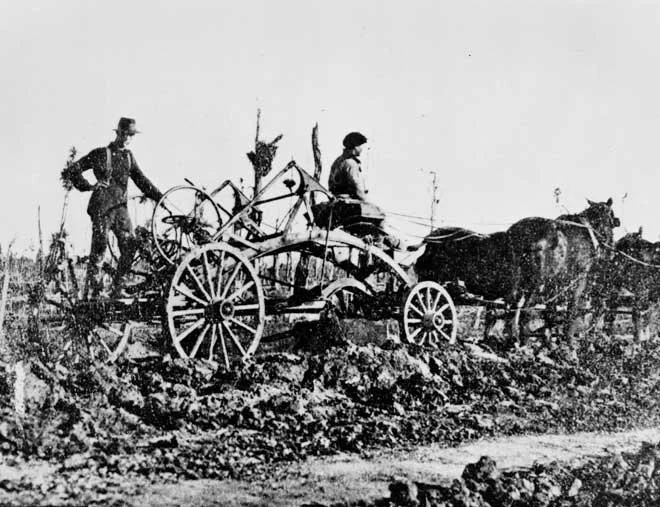
A horse-drawn road grader. Alexander Turnbull Library Reference: 1/2-103439: F
When the road gets upgraded, it doesn’t bring about another wave of equally high-value trips. Instead, it makes the next-most-valuable trips possible. The ones that weren’t quite worth doing before, but now they are—because the better road has made moving around just that little bit easier to do, or made it comfortable to travel just a little bit farther.
That’s not a bad thing. In an ideal world, everybody could easily and quickly get where they wanted to go, and we could move all sorts of stuff to all sorts of places without issue or delay. Making travel easier has very real economic benefits. But there’s an important economic reality to understand:
Each improvement makes it possible to do more things, but the next things we enable tend to be less valuable than the things we enabled before.
This is known as “diminishing returns”, and it is the first reason why modern road projects tend to deliver fairly underwhelming economic benefits relative to their costs. The more we get of something we already have, the less valuable the next increment tends to be.
This applies to the types of trips being made on roads and, interestingly, isn’t usually accounted for in business cases for transport projects (when people try to figure out whether a project is worth doing or not). In these, hypothetical future trips are given the same value as historic trips, even though that’s almost certainly a false assumption.
But it’s not the only type of diminishing return we see in road construction.
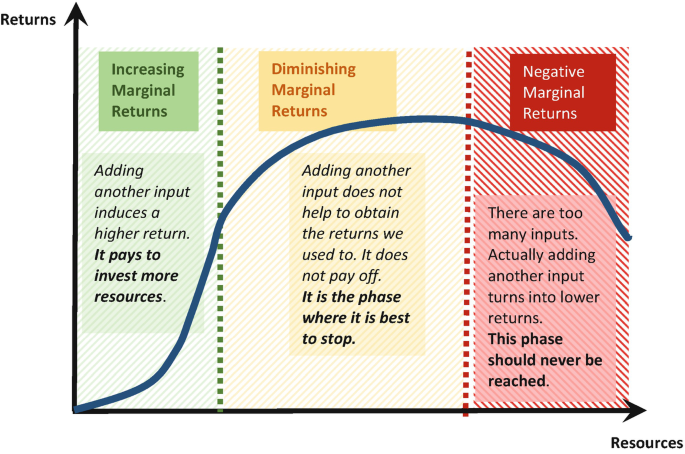
Diminishing Returns by Maria-Carme Riera-Prunera
Faster isn’t always better, either.
If you’ve seen Rory Sutherland’s bit on paceometers, you might be familiar with a great example of the concept of diminishing returns as it applies to travel speed.
A paceometer shows how equal increases in travel speeds translate to lesser and lesser improvements in travel time.
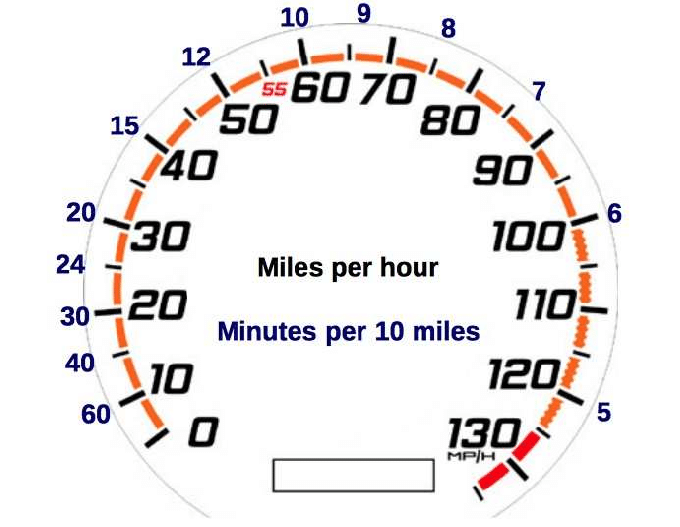
If we imagine the average speed of travel on our muddy horse track is 10km/h, then, (clearly) it would take one hour to travel 10 kilometres (this is, indeed, fairly fast for a horse track; but bear with us).
Upgrade that track to a simple dirt road, and a truck might bounce along at an average speed of 30km/h. That’s 20km/h faster than before, and now, travelling 10 kilometres takes just 20 minutes—a saving of 40 minutes, or 66% of the travel time.
Thanks to the economic uplift of the new dirt road, the town is booming, and it’s decided: The road is to be paved. After a coat of chip-seal and asphalt, the road now supports an average travel speed of 50km/h. Once again, that’s 20km/h faster than before.
But how does that translate to travel time savings? At an average speed of 50km/h, our 10km journey now takes 12 minutes. That translates to a saving of just 8 minutes, or 40% off the previous travel time.
The first iteration made a big difference in how good travel on the road was. The next iteration saved a chunk of time, but didn’t make anywhere near as big an impact.
These values are known as “marginal benefits”, and it is these marginal benefits that reduce with each iteration.
So what if we carry this through to present-day Aotearoa?
Right now, we’re often upgrading roads where travel speeds average around 90km/h, pushing them up towards 110km/h.
Our 10km journey, on these roads, will be changing from 6 minutes 40 seconds to approximately 5-and-a-half minutes—a saving of just 1 minute 10 seconds.
As Mr Sutherland concludes in his presentation on the topic:
“What it effectively says is… Going quite a bit faster when you’re going slowly is a really big gain. Going very fast when you’re already going fast… Well, that has a different value” (to paraphrase).
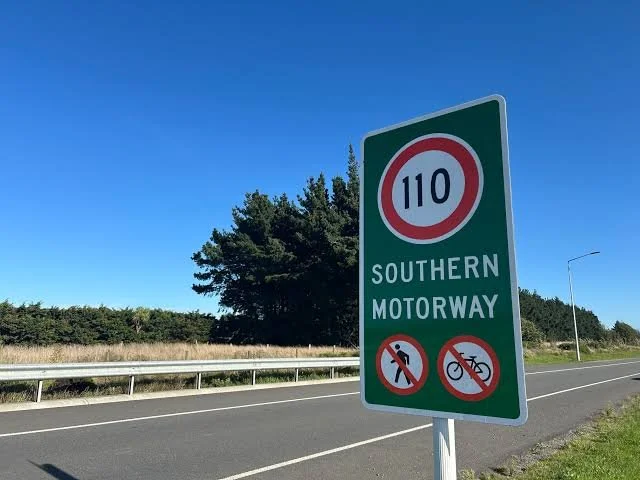
110km/h sign in Christchurch. Image credit: NZHerald
When the horse track became a road capable of carrying trucks and other motorised traffic, that was a step-change. But the next iterations are unlikely to ever achieve the same impact.
Combined with the diminishing value of added trips, the diminishing returns of increases in travel speed mean that moving more traffic more quickly brings about less and less marginal benefit over time.
We can pave the road. Put a bridge across the river. Straighten tight corners. Add passing lanes. Put a tunnel under the mountain to skip the biggest hill-climb. Each of these upgrades would make travel on the road easier—but none would unlock the same potential that the first road did.
This is where the economics of modern road building gets really interesting: Because the benefits are getting smaller, just as the engineering gets harder.
The first road is the cheapest
Imagine you’ve been tasked with connecting an otherwise isolated town to the national roading network. Your first approach is going to be “where is the best place to build a road that makes this connection possible?”
The first roads to new places tend to be sympathetic to the landscape: Following the contours of geographical and geological conditions like waterways, hills, wetlands and mountain passes. In flat areas, the first roads tend to run along firm soils; and in steeper terrain, roads usually end up in valleys or running along ridges.
In other words: The road is made to fit the landscape. Nature made the route long before the surveyors turned up.
These early routes are optimised for practical buildability, not fast travel speeds. They may be circuitous—going around obstacles like swamps or steep inclines. They may descend down into river valleys to reduce the cost of building large, complex bridges across wide divides. They may be narrow when skirting along the banks of a river or climbing up a mountain ridgeline. This pathway makes the road cheaper and easier to construct, but makes the driving trip longer and slower.
So what happens when we want to move more things, more quickly?
The design question changes.
Instead of asking “where can we build a road in a practical way?”, we start asking “what would the road look like if we designed it around how we want traffic to move?”
Instead of planning the road around the environment, we start to plan the environment around the road. Hills get cut, depressions get filled, valleys get bridged and mountains are tunnelled. When we build for speed, we want more gentle gradients, sweeping curves and longer sightlines—which nature rarely provides.
And if we want to move a whole lot more traffic, then we don’t just want to change the environment around a focused, narrow route: We want to carve out whole swathes of mountainsides or level vast areas of land to create space for passing lanes, hard shoulders and interchanges that allow lots of vehicles to interact without slowing each other down.
The faster we ask the road to be, the more of the landscape we have to engineer around the vehicle. And changing nature to suit our driving habits is a very expensive way to build a road.
Modern highway building in Aotearoa often takes roads that were designed around the landscape and replaces them with landscapes engineered around a road.
The Pūhoi–Wellsford road is a good example: The old route follows the contours of the land; the new one cuts through them—with elevated spans and major earthworks delivering a faster, higher-capacity route. A similar proposal has been put forward for Warkworth to Te Hana, where a map of the route clearly shows an old road following the shape of the land, and a new one being engineered to straighten out the journey.
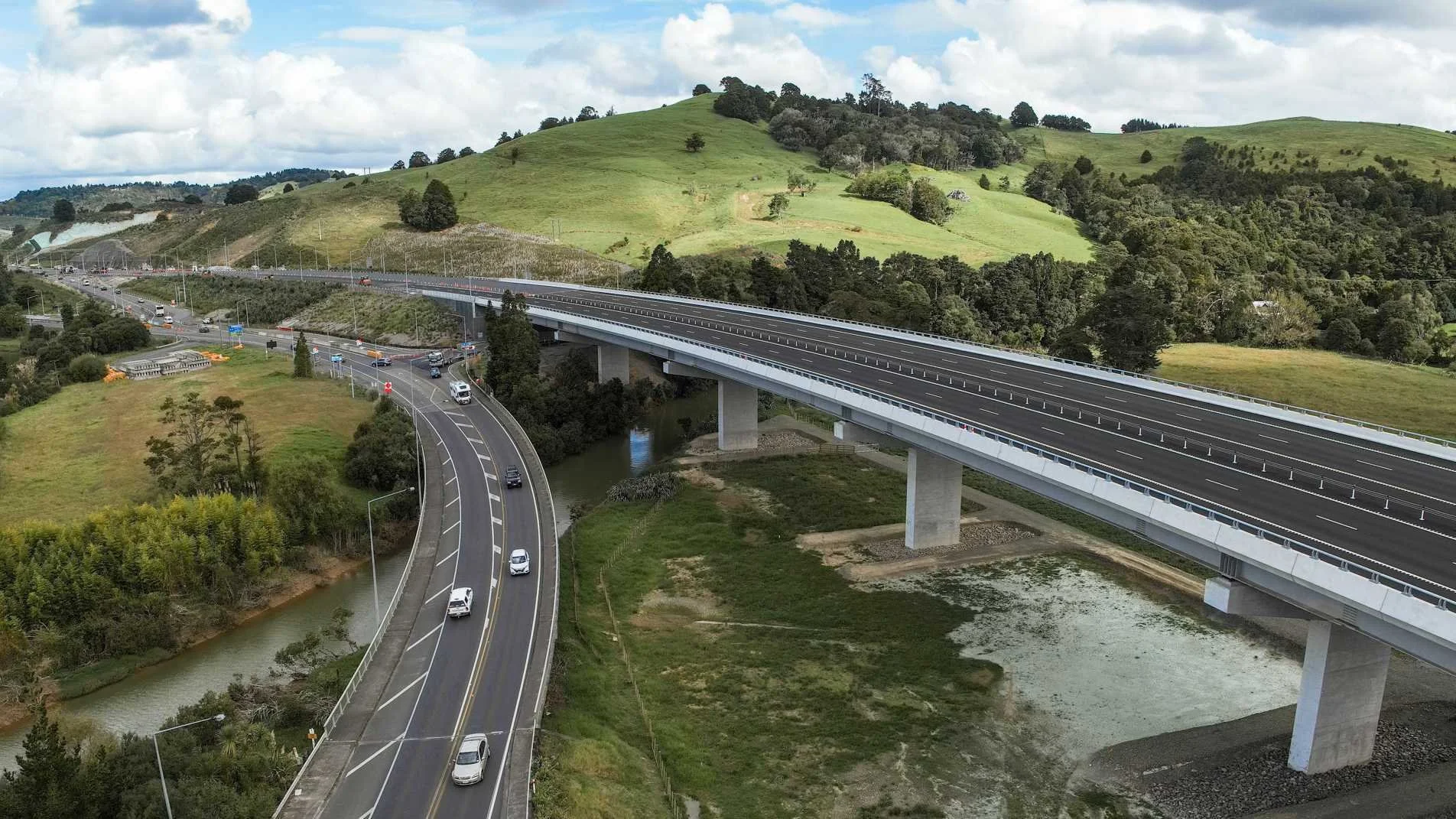
Puhoi to Wellsford demonstrates road duplication shifting from a landscape-sympathetic approach to a reshape-the-environment-around-the-vehicle approach. Image: NZTA Waka Kotahi
These types of projects tend to deliver even lower economic returns than upgrading existing roads, because they directly duplicate existing routes that already serve the highest-value trips. We end up with two roads serving the same trips, and only a marginal improvement for some of them.
But shaping the landscape around the vehicle isn’t the only thing that makes newer roads more expensive. The physics of vehicle speeds work to increase costs, too.
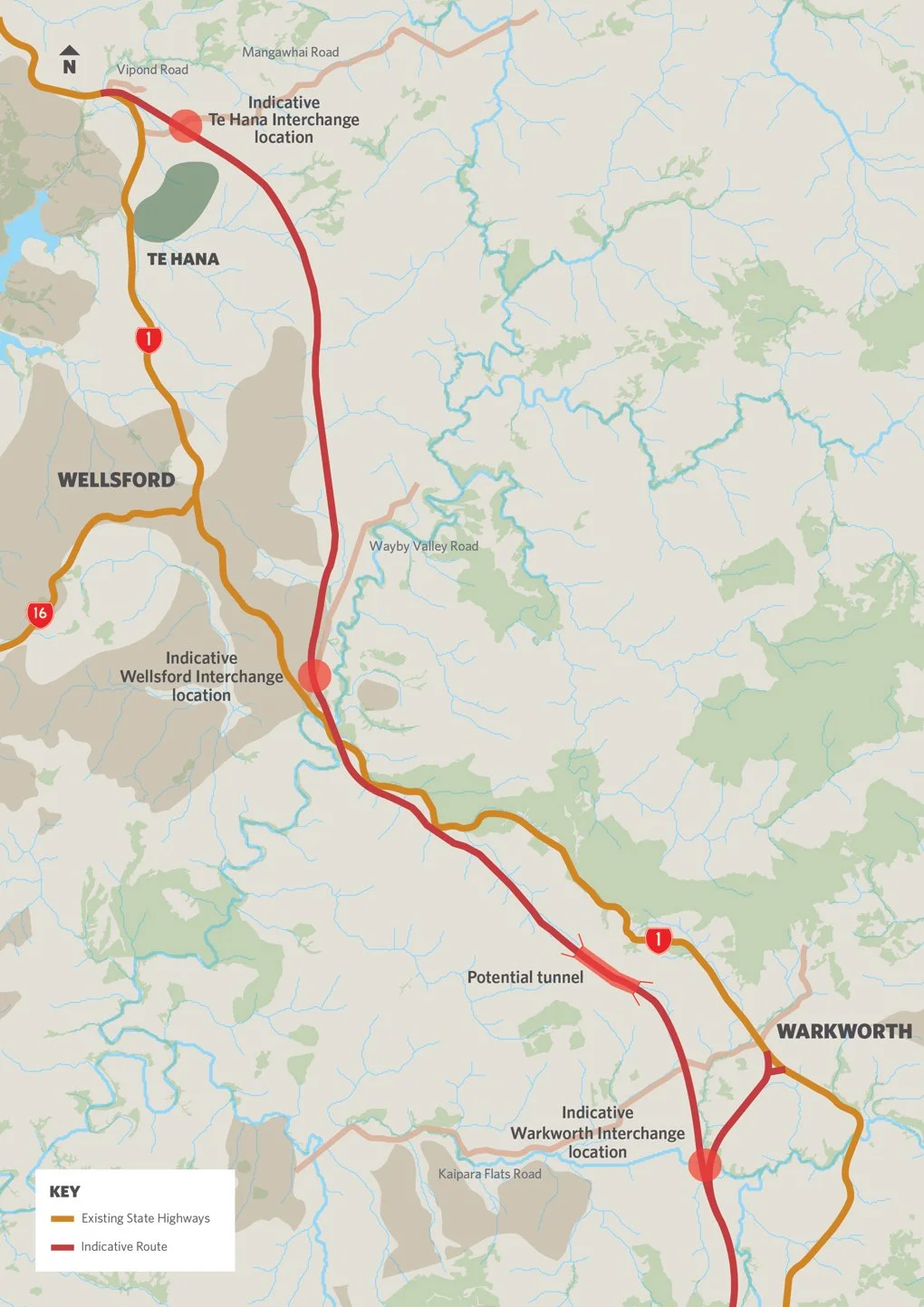
A map of the Warkworth to Te Hana route clearly demonstrates the difference in alignment between a landscape-optimised route (the old road in brown) and a speed-optimised route (the new road in red). Image: NZTA Waka Kotahi
Physics doesn't give us a free lunch
Speed doesn't just make a vehicle move faster. It makes it harder to stop, harder to turn and more destructive when something goes wrong. The faster a vehicle travels, the more demanding the forces acting on the road (and everything that supports the road surface) become.
Those effects don't increase in a simple one-for-one relationship with speed. As speed rises, the forces involved rise much faster.
Imagine a car taking a bend. The road has to push the car sideways to make it change direction rather than continuing straight ahead. At low speed, that's relatively easy. But as the car gets faster, it has much more momentum carrying it forwards.
To make the same turn at twice the speed, the road has to push the car sideways four times as hard. This relationship is described as the square of speed: double the speed, and the force required to make the same turn is four times greater.
Going from 90 to 110 km/h is only a 22 percent increase in speed. But because the relationship is squared, the force needed to make the same-radius turn increases by about 49 percent. That's why you can't simply make an existing winding road a 110 km/h road by putting up a new sign. The road itself has to change, and small speed changes require comparatively larger road changes.
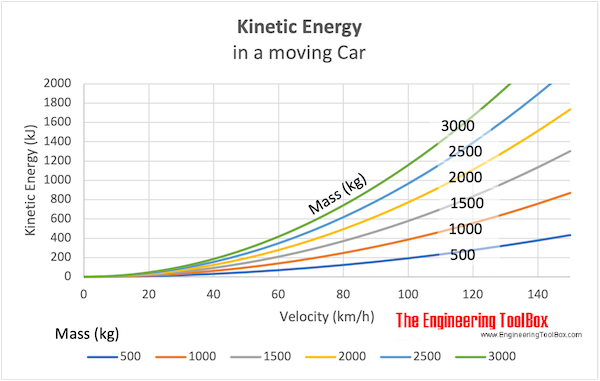
Kinetic Energy in a Moving Car from The Engineering Toolbox.
Force exerted onto the road surface isn’t the only reason road engineering gets more complex as speed increases, either.
At 30 km/h, a driver who starts to drift off-course in their vehicle has a reasonable chance of correcting the mistake before much happens. At 110 km/h, the vehicle is covering more than 30 metres every second. A moment of inattention, an unexpected mechanical or medical problem, or adjusting course to avoid a sudden obstacle can carry the vehicle a long way before the driver can react, brake and regain control.
So higher-speed roads are built with more space to allow vehicles to recover from the unexpected. Wider lanes and big shoulders give drivers some breathing room. Clear zones give an errant vehicle somewhere to run off the road without immediately hitting a tree, pole, ditch or steep drop. Barriers have to be designed to contain vehicles travelling with more momentum.
The faster we enable vehicles to travel, the more room we need to give them when things go wrong. And the more room we need, the more landscape we have to acquire, excavate, pave, drain and maintain.
Higher-speed roads need gentler curves, longer sight distances, more recovery width and stronger safety barriers. They need more space between the road and the things beside it. They need more sophisticated drainage, stronger pavements and more substantial structures. And because of the exponential relationship between force and speed, the engineering behind all of these elements doesn’t increase in a linear fashion as we increase vehicle speeds: Every increment of speed requires a big step up in engineering.
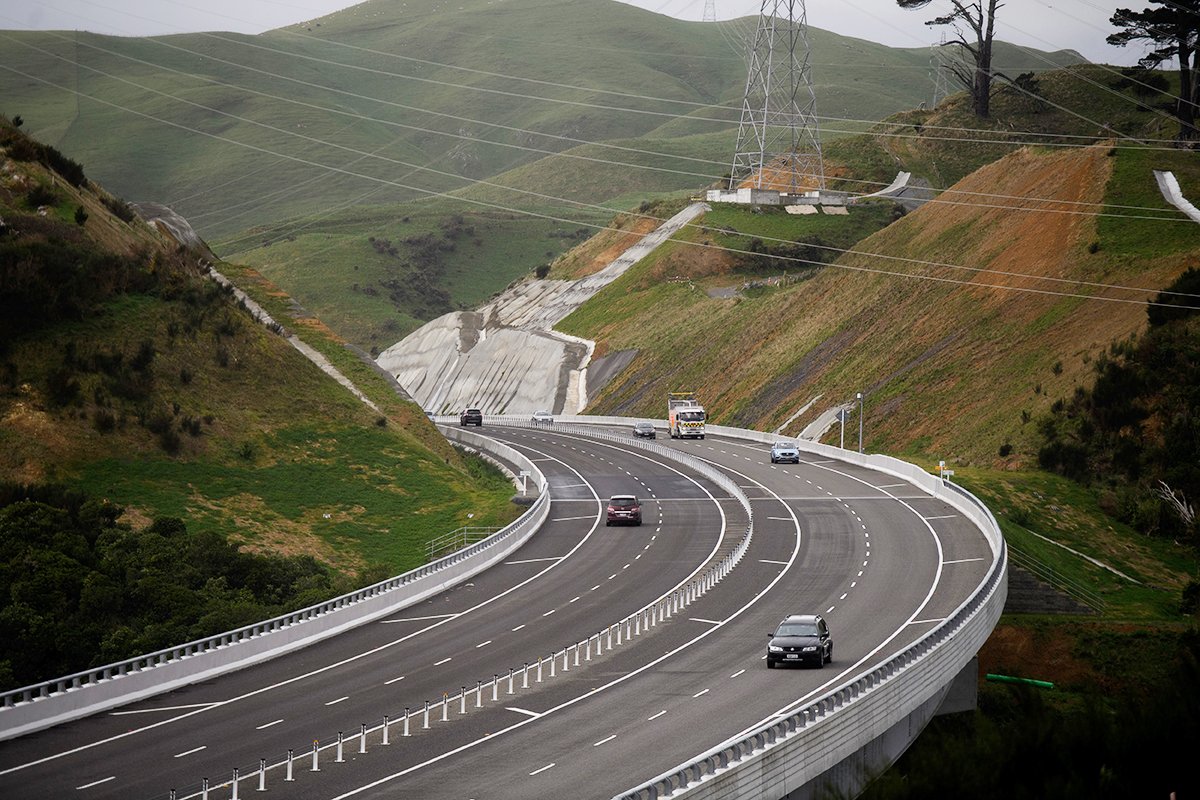
Transmission Gully clearly demonstrates the additional road width required for higher-speed driving. Image: NZTA Waka Kotahi
The same thing happens when vehicles get heavier.
A 50-tonne truck places very different demands on a road from a two-tonne car. Bridges, pavements and other structures have to be designed to withstand the loads imposed by those vehicles, over and over again.
Speed and weight compound each other. A heavy vehicle travelling quickly carries vastly more kinetic energy than a light vehicle travelling slowly. We don't just build roads for vehicles. We build roads capable of surviving the forces those vehicles impose on them.
A little more speed can require a lot more road. And a little more weight can require much stronger structures. Once we ask a road to carry heavier vehicles at higher speeds, the physical requirements of the entire corridor change—and those changes come at very high cost.
But these aren’t the only costs associated with more driving. All driving imposes costs onto others and the environment, known as “externalities”, and it’s these added costs that really eat up any potential benefit from big road-building projects.
Excess driving costs more than it creates
The economic value of additional travel gets smaller as we enable more of it. And the faster and easier we try to make driving, the more it costs to achieve those incremental (and diminishing) gains.
But there is a third problem: When we make driving faster, easier or cheaper, people don't just keep making the same trips they were already making.
Instead, they drive more.
This is induced consumption. Make driving more attractive and people will change when, where and how often they travel.
Building bigger roads doesn’t just make a minor change to existing travel patterns. It changes the economics that determine where people choose to locate homes and businesses, where they choose to go, and how they choose to get there.
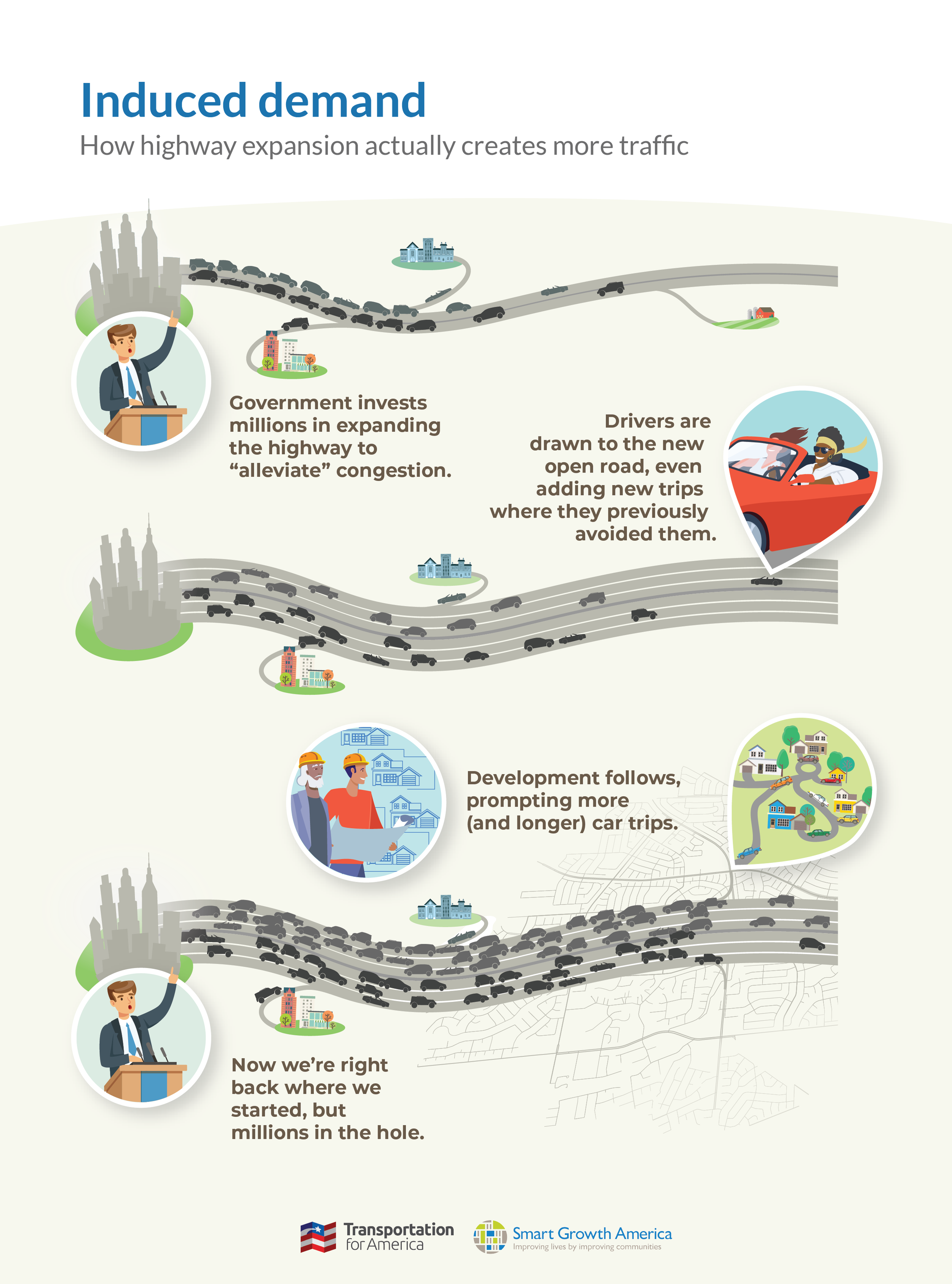
Induced demand explainer by Transportation for America
This matters because every vehicle trip comes with costs that scale up with the amount of distance travelled. Every kilometre driven in a vehicle creates crash risk, congestion, pollution, wear and tear, or contributes to physically inactive lifestyles. Some of these costs are paid for by the driver, but most of them are what economists call “externalities”—a cost created by the actions of one party that is paid by somebody else (usually the general public).
These costs filter through the economy as higher taxes and building rents; less valuable properties and struggling commercial centres; travel delays; injuries, illnesses and disabilities; and climate instability which has harmful consequences for food, water, shelter and human livelihoods.
Costs become even greater when we start to consider the impacts that road building has on the economics of land use. By making land further away more attractive for development, designing and building roads for higher speeds results in things getting spread out over ever-increasing distances. This comes with enormous and ongoing infrastructure costs.
When homes and businesses spread out because of road building, they also need water, energy, waste and telecommunications infrastructure. Pipes and electricity lines need to span much greater distances, and rubbish trucks need to drive further to pick up waste. Governments may need to build new schools, fire stations, hospitals and police stations if they want to provide essential services near to where people live.
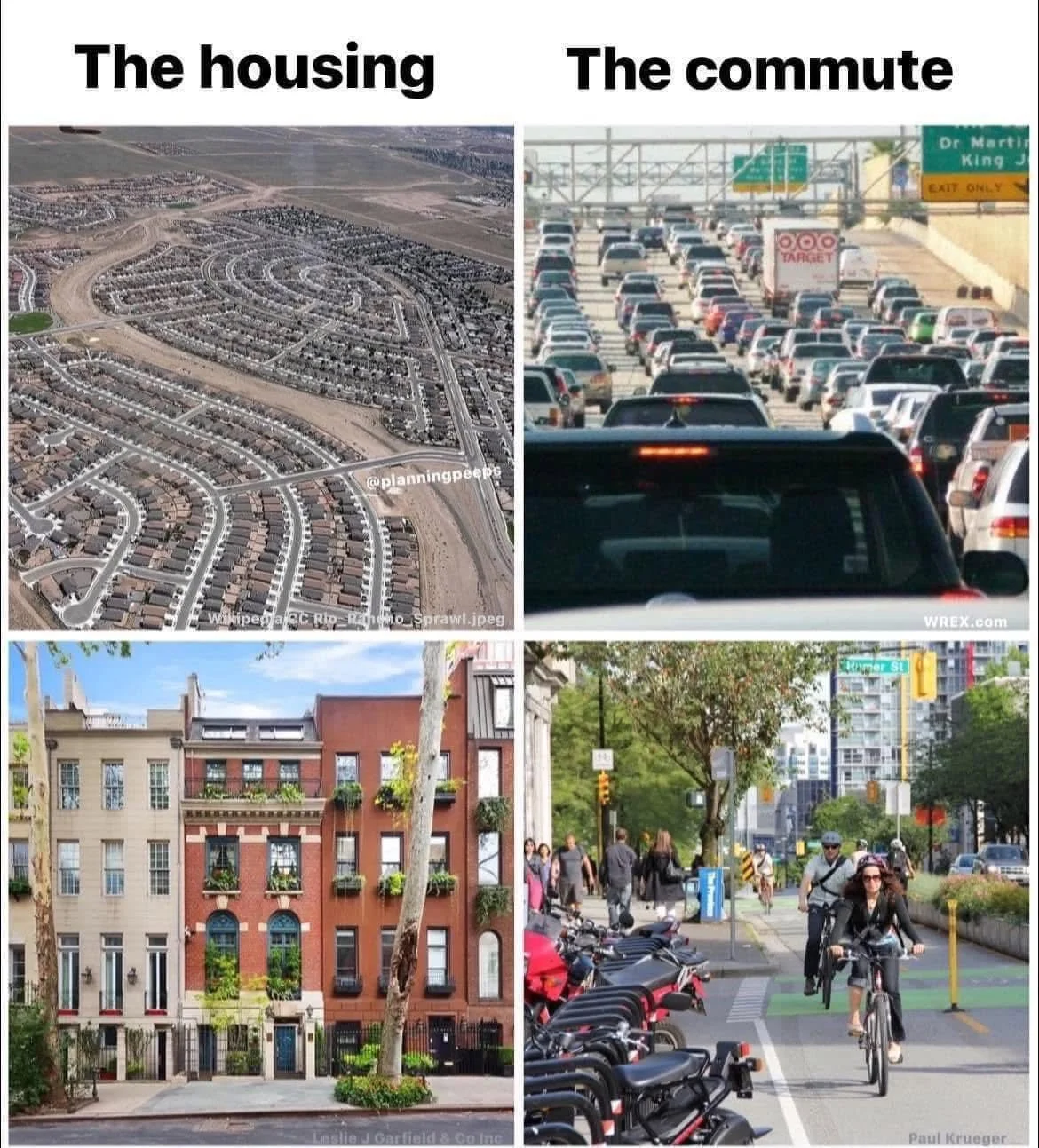
The housing vs The Commute, from IMM Design Lab.
All of these things happen as a consequence of building roads designed for faster speeds, and they incur very real economic costs.
The result is a peculiar economic trade-off:
We spend more money to make driving faster and easier;
This induces more driving, and;
The additional driving creates costs that ripple through the rest of the economy.
For every kilometre driven, we pay for more roads, more maintenance, more parking, more dispersed infrastructure, more congestion, more crashes, more pollution and more land consumed by transport.
But additional distance travelled involves ever-declining marginal benefits. The additional kilometres driven (because it has become easier to do so) don't automatically create more economic productivity. Because the highest-value trips were already being made, additional trips tend to be further down the economic pecking order—while still imposing the same costs on everyone else.
This is the point at which more mobility can become an economic drag: We are paying increasingly more to enable increasingly more driving, while getting less and less economic value from each additional kilometre driven—but also paying additional cost that goes up as distance driven increases. The costs start to outweigh the benefits, and the whole exercise fails to not only bring about any real economic gains, but to be a net economic loss.
This is the point known as “negative marginal returns”, when the costs of trying to do more of something outweigh the benefits doing that thing achieves.
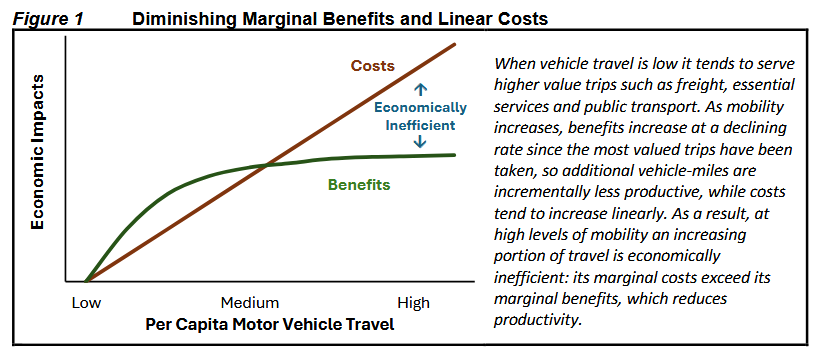
The Mobility-Productivity paradox from Todd Litman.
What we could do instead
The good news is that we can apply the same lessons and logic in reverse. Moving people without cars is cheaper than moving them in cars. A protected cycleway can move people using a fraction of the space and material required for a motorway lane. A bus can replace dozens of private vehicle trips; a train can replace hundreds. Walking, compared to driving, requires almost no transport infrastructure at all.
The same applies to speed. Slower roads can be simpler roads. Lower speeds allow tighter curves, narrower lanes, shorter stopping distances and less elaborate roadside engineering. We can make streets safer and more pleasant without cutting through mountains, building enormous bridges or reshaping the landscape around ever-faster vehicles. The economically smart approach isn't necessarily to move every vehicle further and faster; it's to move people and goods efficiently, which also results in keeping our use of land more compact and making the distances people need to travel shorter.
So perhaps the Minister's productivity challenge isn't to find new and ingenious ways to build ever faster roads. Instead, our advice to the minister would be this:
Investigate why it's so difficult to build a decent bike path.
If we're serious about getting more economic value from every dollar we spend on transport, the laws of physics—and the evidence—suggest we should start moving more people with fewer vehicles, and spending less money making them travel further and faster.
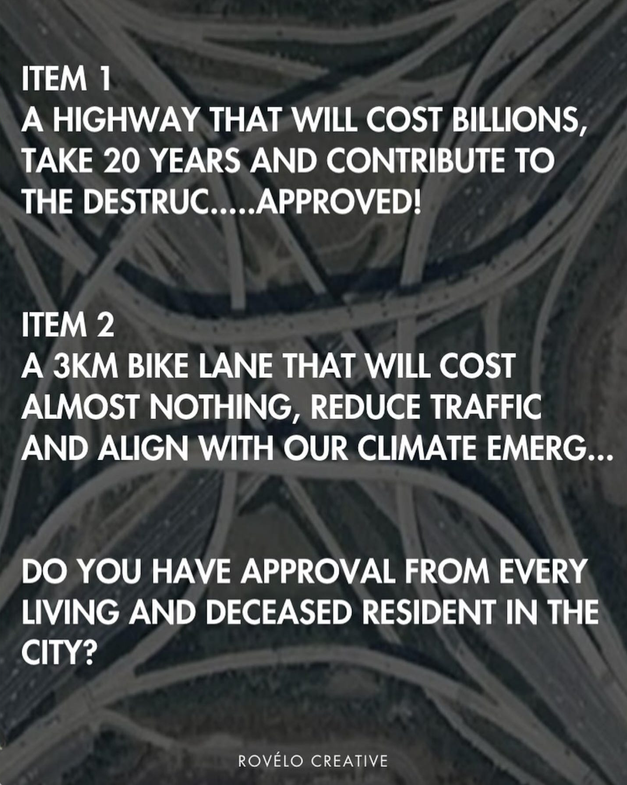
Approval by Tom Flood/Rovelo Creative
